Mt. Baker's Terrain, Lift by Lift
Mt. Baker runs 8 fixed-grip quads and 2 handle tows across two base areas, no high-speed lifts. Here's what each chair serves and which terrain is off-limits.
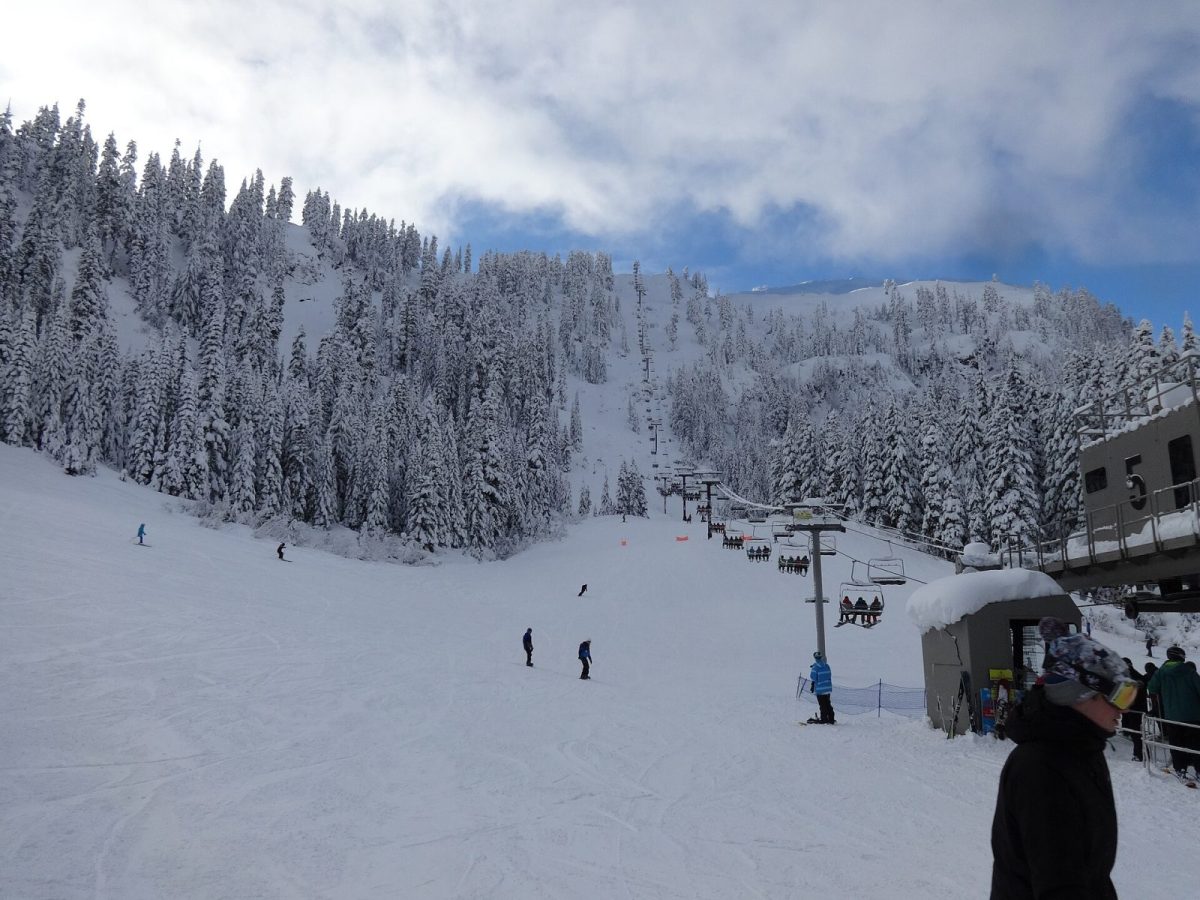
Mt. Baker runs eight fixed-grip quad chairlifts plus two handle tows — ten lifts total, none of them high-speed detachables — spread across two base areas and 1,589 vertical feet of terrain. No lift here loads faster than the next skier can find the chair; that's a deliberate, old-school character, not a limitation to work around.
Two base areas, one mountain
This article covers the lifts and terrain specifically; for the full picture of planning a visit — hours, season length, what to do if you're not skiing — start with our complete visitor's guide to Mt. Baker Ski Area. Mt. Baker's base sits at 3,500 feet, its top at 5,089 feet. You start your day at one of two separate base areas: White Salmon, at milepost 52 on SR 542, and Heather Meadows, three miles farther up the highway at milepost 55. They're connected by lifts and terrain, not by a shared parking lot, and which one you park at changes which chairs are closest to your car. Our parking guide breaks down that choice in more detail than this article needs to.
The eight chairs
| Chair | Name | Base area | Character |
|---|---|---|---|
| 1 | Pan Dome | Heather Meadows | No safety bar — experts-only since 2011 |
| 2 | Heather | Heather Meadows | Beginner terrain |
| 3 | Up & Up | Heather Meadows | Continuous loop; terrain park added 2020–21 |
| 4 | Up & Up | Heather Meadows | Continuous loop; terrain park added 2020–21 |
| 5 | Shuksan Arm | Heather Meadows | Accesses upper-mountain terrain |
| 6 | Sticky Wicket | Heather Meadows | No safety bar — experts-only since 2011 |
| 7 | Espresso | White Salmon | Serves the White Salmon base |
| 8 | White Salmon | White Salmon | Longest lift on the mountain; built 1991 |
Two additional handle tows round the mountain out to ten total lifts. The fact base behind this article doesn't name them or specify which base area each serves — treat them as the low-speed, low-commitment option for absolute beginners at whichever base you're skiing, and confirm placement on the current trail map.
Chairs 3 and 4 run as a continuous loop rather than the stop-and-load pattern of the others, which is worth knowing if you're timing a meetup with a group — you may not get the exact same chair back that you got off.
The two chairs you can't casually ride
Chairs 1 and 6 have no safety bars. That's not a maintenance gap; it's a 2011 decision that reflects the terrain they access, and both are designated experts-only as a result. If you're a strong skier looking for the steepest lift-served terrain on the mountain, this is where to start asking locals. If you're not, there's no ambiguity here — these aren't chairs you end up on by accident from the beginner side of the mountain, and they're not where a lesson group will ever be sent.
Do the two base areas actually connect?
A single lift ticket covers both White Salmon and Heather Meadows, and the lift system is built to move skiers between the two rather than keep them separate. The fact base behind this article doesn't spell out the exact chair-to-chair sequence for getting from one base to the other, so if that connection matters to your day — say, you parked at White Salmon but want to start at Heather Meadows — ask ski patrol or check the current trail map at either base before you commit to a route across the mountain.
The terrain park
Mt. Baker added a terrain park at Chairs 3 and 4 in the 2020–21 season. Specific features change from year to year at most terrain parks, and this one is no exception — the fact base for this article doesn't detail current jumps, rails or box counts, so treat "there's a park here" as the reliable part and check mtbaker.us or ask at the base for what's actually built for the current season.
Night skiing: new, and not guaranteed to continue
Mt. Baker ran its first night skiing session in the mountain's history on March 13–14, 2026, seventy-three years after the ski area opened — a two-day trial at White Salmon on Chair 7 and one handle tow, included for both season pass and daily ticket holders. Whether it becomes a regular fixture of future seasons hadn't been confirmed as of this writing. If a lit evening session is part of your plan, check mtbaker.us directly rather than assuming it repeats — a single trial run is a promising sign, not a standing policy.
Named runs
The runs named in current sources split cleanly by ability:
- Beginner: Nose Dive, White Salmon, Daytona
- Expert: Pan Face, The Chute, Gabl's
That's a shorter list than the mountain's actual run count — Mt. Baker's terrain includes plenty of unnamed or informally named intermediate skiing between those two ends, and the current trail map on mtbaker.us is the more complete reference once you're planning turn-by-turn. One naming note worth flagging directly: don't trust any source, including a version of this article, that calls a zone "Canyon" — that term couldn't be verified as official mountain terminology and shouldn't be treated as a real landmark when you're navigating.
What's in-bounds, and what isn't
This is the part worth reading twice if you're used to a resort with a fenced boundary. Mt. Baker runs an open-boundary policy, not a gate system — you can ski or ride out of the resort boundary without checking in or out anywhere, and responsibility for what happens next sits entirely with you.
Two zones get referenced constantly by locals and neither is patrolled terrain:
- Shuksan Arm ("The Arm"), above Chair 8
- Hemispheres, off Chair 8's far side, a set of short steeps that loop back toward the lift
Both are backcountry, not in-bounds terrain, regardless of how close they sit to a lift you just rode. That means a beacon, shovel and probe, a partner, and a check of the day's NWAC forecast before you duck a rope — not optional extras, but the baseline for going there at all. Table Mountain, Herman's Saddle and Swift Creek, reached via the Backcountry Lot near Heather Meadows, sit in the same category. None of this is terrain to treat as an extension of your lift ticket, and none of it is patrolled the way the runs under Chairs 2 through 5 are.
It's also worth saying plainly: an open boundary is a policy about access, not an endorsement of skill level. Mt. Baker doesn't stop you at a rope and ask whether you're carrying gear or have checked the forecast. That responsibility sits entirely with whoever clicks into their bindings, every time.
Hours and when lifts are actually running
Mt. Baker operates 9:00 a.m. to 3:30 p.m. daily during the season, which typically runs from late November or mid-December through late April — though both ends of that window move with snowpack, not the calendar. Not every lift necessarily spins on every operating day; wind holds, low snow at a given elevation, or maintenance can idle a specific chair while the rest of the mountain runs normally. Check current lift status on mtbaker.us the morning of your trip rather than assuming every chair listed here is open.
Building a day around specific lifts
- First-timers and lesson groups stick to Chair 2 (Heather) and the handle tows, full stop.
- Confident intermediates have the most terrain to explore off Chairs 3/4 and 7, without wandering into the no-safety-bar chairs by mistake.
- Experts looking for lift-served steeps start at Chairs 1 and 6, understanding those chairs exist specifically because the terrain below them demands it.
- Anyone curious about backcountry access treats Chair 8 as a jumping-off point to The Arm or Hemispheres only with avalanche gear, a partner, and a current NWAC check — not as a shortcut to more in-bounds vertical.
If your group spans more than one of these categories — a common setup for a multi-generational weekend — plan a midday regroup rather than assuming everyone naturally ends up in the same lift line. Our lessons and rentals guide covers what to book for the beginners in the group, and our lift ticket guide has current pricing for however many days you're planning.
A multi-lift, multi-day weekend is easier to justify once lodging isn't adding a long commute on top of lift lines. Cabins in Glacier sit about 30 minutes from White Salmon, close enough to ski both base areas across a weekend without a different hotel each night.
FAQ
How many lifts does Mt. Baker have?
Ten: eight fixed-grip quad chairlifts (Chairs 1 through 8) and two handle tows.
Does Mt. Baker have any high-speed lifts?
No. All eight chairlifts are fixed-grip, not detachable-quad or high-speed lifts.
What's the vertical drop?
1,589 feet, from a 3,500-foot base to a 5,089-foot summit.
Which chair is best for beginners?
Chair 2, called Heather. Chairs 1 and 6 are the opposite end of the spectrum — no safety bars, experts-only since 2011.
Can I ski from the resort straight into the backcountry?
Physically, yes, because Mt. Baker uses an open-boundary policy rather than gates. That doesn't make it in-bounds terrain — Shuksan Arm and Hemispheres both require avalanche gear and a current NWAC forecast check, not just a lift ticket.
Is there a terrain park?
Yes, added at Chairs 3 and 4 in the 2020–21 season. Specific features vary by season — check current conditions before planning a park-focused day.
Does Mt. Baker offer night skiing?
It ran a first-ever night session on March 13–14, 2026, at White Salmon on Chair 7 and one handle tow. Whether that continues in future seasons wasn't confirmed as of this writing — check mtbaker.us directly.
Can I ski between White Salmon and Heather Meadows on one ticket?
Yes, one ticket covers both base areas. The exact route between them depends on which lifts are running that day — check the current trail map or ask ski patrol if you need to move between the two mid-day.
Check mtbaker.us for the current trail map and daily lift status before you go — which chairs are spinning changes with weather and snowpack, not just season to season.
*Written by the team at Stay at Mt Baker, who manage cabins in Glacier, Maple Falls,
Mt. Baker Rim, Glacier Springs, Snowline, Snowater and Silver Lake.
Last checked: August 2026.*